Print Culture in Cambridge
By Beth Folsom, 2026
At the height of the Great Depression, the Roosevelt administration created the Works Progress Administration to employ millions of jobless Americans completing public works projects around the country. While the majority of the jobs it created in the mid-1930s were in sectors such as construction and infrastructure, the WPA also provided funding for artists and writers, including many large-scale murals in public buildings such as post offices, schools and libraries. During a time of great economic hardship, this federal funding not only allowed those in creative fields to support themselves, but also enabled the creation of artworks that captured local history in a dynamic way.
A 1934 Cambridge Chronicle article detailed a meeting of the Cambridge School Committee at which a young artist requested permission to paint a mural inside the newly constructed Rindge School building. The reporter described the woman as “an attractive young artist and valedictorian of the class of 1929 at C.H.L.S.,” or Cambridge High and Latin School. Tracy, who had graduated from Radcliffe College the year before, explained to the committee that she would supply her own materials, and that her salary would be paid by the Civil Works Administration, a precursor to the WPA. Her pitch was successful, and she completed the mural several months later.
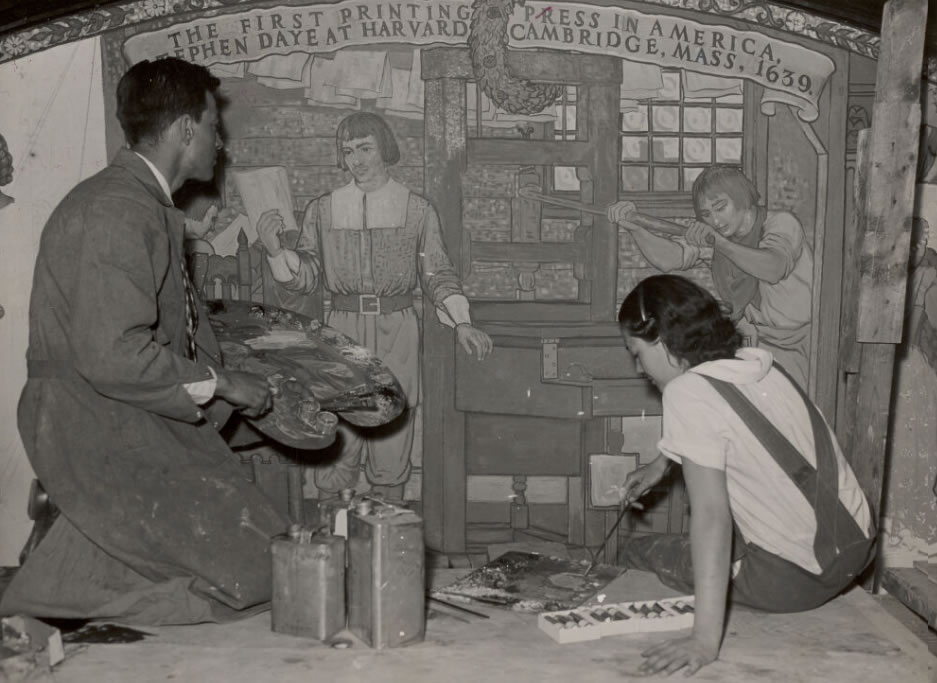
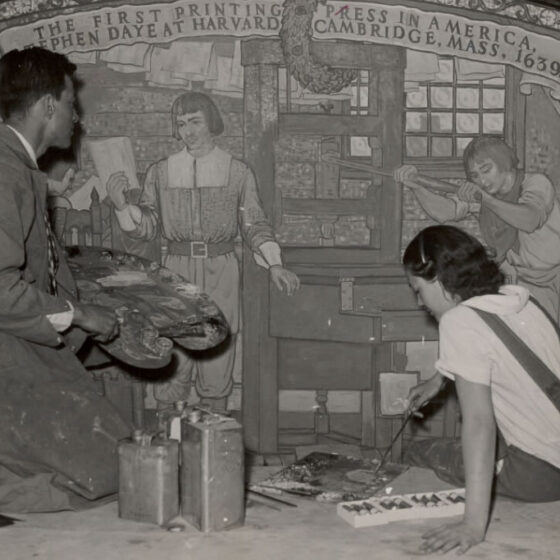
At the same time Tracy worked on her piece for Rindge, she assisted fellow artist Arthur Willis Oakman in designing and painting a series of murals for the main branch of the Cambridge Public Library. The series, a visual depiction of the divisions of knowledge that make up the Dewey decimal system, include images of religion, the fine arts and the history of books and printing, which traces its development from ancient Babylonia to the invention of the printing press to Cambridge’s 20th-century status as a national printing and publishing center.
The Cambridge Tribune reported in July 1934 on the unveiling of the library murals, praising their accurate and realistic portrayal of Cambridge history, particularly in the series on printing. One panel features Johannes Gutenberg, who invented the printing press around 1450 in Mainz, Germany; this press revolutionized the distribution of the printed word with its moveable type and oil-based ink, allowing works on paper to be created and disseminated at a scale never before possible. The Gutenberg Bible, produced in 1455, was the first book produced in the West using metal moveable type, and was especially important during the Protestant Reformation, which emphasized the individual’s direct relationship with a supreme being through the word rather than by the interpretation and intercession of clergy.
The mural’s other panels depict William Caxton, a merchant and writer who is believed to have introduced the first printing press to England in the 1470s, as well as Benjamin Franklin, a printer by trade and a fierce proponent of the power of newspapers and broadsides to inform the public and spur them to action during the Revolutionary era. The top panel of the mural is reserved for Cambridge’s own contributions to the history of printing, showing Stephen Daye and two of his assistants at work. Daye is believed to have brought the first printing press to British America in 1638, when he boarded the ship John of London with his family and his financial benefactor, the reverend Joseph Glover. Glover – the press’ owner – died aboard the ship during its voyage from England, but Daye was in debt to him for his trans-Atlantic passage and that of his household. He became indentured to Glover’s widow, Elizabeth, and the contract that passed to her upon her husband’s death made Elizabeth the owner of the press and obligated Daye, his sons and stepson to work for her in her Cambridge shop until their debt was repaid. Daye began by printing broadsides, pamphlets and newspapers, and in 1640 produced the Bay Psalm Book, the first book published in the American colonies.
One of the most significant events in the history of printing in Cambridge, although not depicted in the library mural, was the creation of Mamusse Wunneetupanatamwe Up-Biblum God, more commonly known as the Eliot Indian Bible. John Eliot had been working as a missionary to the Indigenous community in Natick for three decades when the volume was printed in 1661, marking the first translation of the Judeo-Christian scriptures into an Indigenous American language, as well as the first complete bible printed in the North American colonies. Eliot’s attitudes toward and treatment of the Natick Christian Indian community make his legacy a problematic one in many respects, and his translation (with voluminous help from Indigenous scholars, including those at Harvard’s Indian College) reflects his foundational belief that an adherence to English Protestant Christianity was necessary for Indigenous peoples to attain social and political equality with whites. Ultimately, religious and cultural assimilation were not enough to spare the so-called “Praying Indian” communities from suspicion, removal and death at the hands of the colonial government during Metacom’s Resistance in the 1670s, not long after Eliot’s bible was published.
Cambridge continued to be a center of colonial New England printing during the 17th and 18th centuries, thanks largely to a state law saying no printing could be done outside of Cambridge (a result of Harvard’s successful lobbying attempts). The creation of a University Press came in 1802, and Henry O. Houghton created the Riverside Press in 1852 and went on to publish the works of Longfellow, Thoreau, Hawthorne and Henry James. In 1880 Houghton partnered with his friend George Mifflin and together they founded and led the publisher Houghton-Mifflin, still in existence. In 1895 the Athenaeum Press, another distinguished publisher, moved to Cambridge. In 1913, the Harvard University Press was founded; it remains a leader in academic publishing and still has an office in Harvard Square. Google Books, the online book depository and search engine, was developed at Google’s Kendall Square offices with help from libraries in the Boston and Cambridge area, as well as academic institutions such as Harvard and MIT. Although the landscape of printing today looks very different from four centuries ago, when Daye arrived with his printing press, Cambridge remains an important part of the story of print culture in America.