
Search Results

…level of diversity than most people recognize.” After colonization, the area had Yankee farmers, then Irish brickyard workers replaced by French Canadian brickyard workers. Next in line were the upwardly…

…brick building fronting on Main Street, two large wings were added in 1848, extending on Osborn Street, known as the east and west wings. [Main Street running roughly east and…

…the brick structure at 25 First St., now known as The Davenport. As far back as the 1600s, coastal Massachusetts was a center of shipping, shipbuilding and lumber milling and trading,…

…on the senses. Of course, Cambridge had been making everything from bricks to glass to ice for years, but as it approached a peak population of 120,000 in 1925, the…

…of the 1960s, he decided he couldn’t very well leave the window exposed anymore. We bricked it in, which was actually more practical, because by bricking it in it allowed…

…it was near the sidewalk in an indented parapet. In addition, it was tarnished, was almost the size of a brick, and had a few strands of ivy hanging over…

Tuesday, June 11 5-7 pm Cambridge Common Free; no registration required Ages 3+ Cambridge was once home to a thriving brickmaking industry. Join us for a family-friendly drop-in event on…
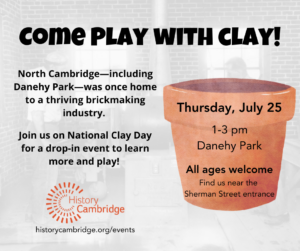
Thursday, July 25 1-3 pm Danehy Park (near Sherman Street) Free; no registration required Ages 3+ North Cambridge was once home to a thriving brickmaking industry. Join us for a…
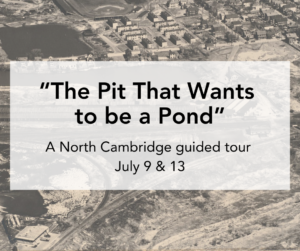
…about the history of Jerry’s Pit. We appreciated everyone’s insights and great questions! This tour will explore the development of North Cambridge through the lens of the claypits and brickyards…

…institutions Cantabrigians needed but wanted to push to the edges of the city’s boundaries. Slaughterhouses, tanneries and brickyards were all necessary industries, but those in the more densely populated (and,…