
The roots of Veterans Day were explicitly in peace, disarmament and a world court
By Beth Folsom, 2026
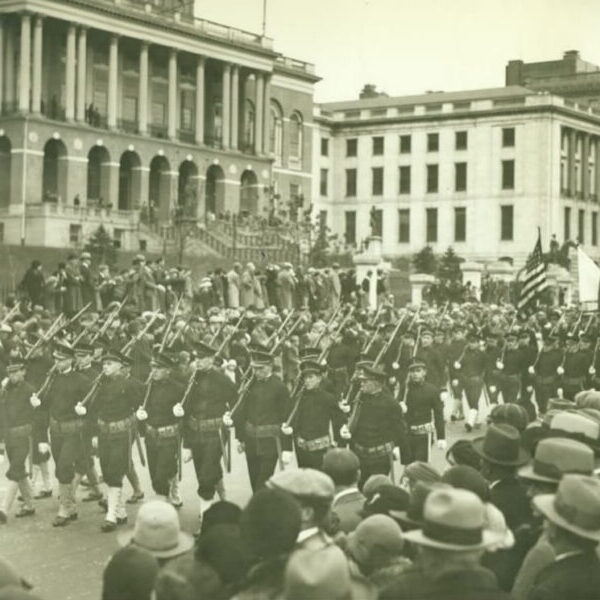
Ten years after the end of what would come to be known as World War I, Massachusetts officially recognized Armistice Day as a state holiday. Marking the end of hostilities at 11:11 a.m. on November 11, 1918, Armistice Day had been celebrated across the United States from its first anniversary in 1919, and would later be renamed Veterans Day. But just what the day symbolized in its first decade was open to debate, with opinions varying on the holiday’s meaning and its usefulness to contemporary Cantabrigians. What did Cambridge – and the nation as a whole – value in the wake of such a global conflict, and how did differing approaches to Armistice Day reflect the complexities of this period?
Although the United States was only embroiled in the war officially for about a year and a half, from April 1917 to November 1918, the country’s role as a crucial supporter of and supplier to Great Britain, France and other allied powers before becoming a full combatant meant the war was very much in the minds of Americans well before 1917. Once the country entered the war, young men from every city and town were called to serve. There is no official record of how many soldiers and sailors from Cambridge served in the war, but Massachusetts as a whole sent more than 189,000 fighters; at least 264 from Cambridge lost their lives in combat.
Cambridge mayor Edward Quinn issued a proclamation on the first anniversary of the armistice, November 11, 1919. In it, he noted that businesses would close and “the people everywhere will, in a joyful way, recall the importance of this event, which was practically the ending of the great war with Germany.” His statement, printed in the Cambridge Chronicle, also shared the city’s plans for marking the day, which included speeches by prominent politicians and representatives of the Army and Navy, a band concert and a reading of the Declaration of Independence by a local high school student. The commemoration would close with the singing of the “Star Spangled Banner” by all assembled.
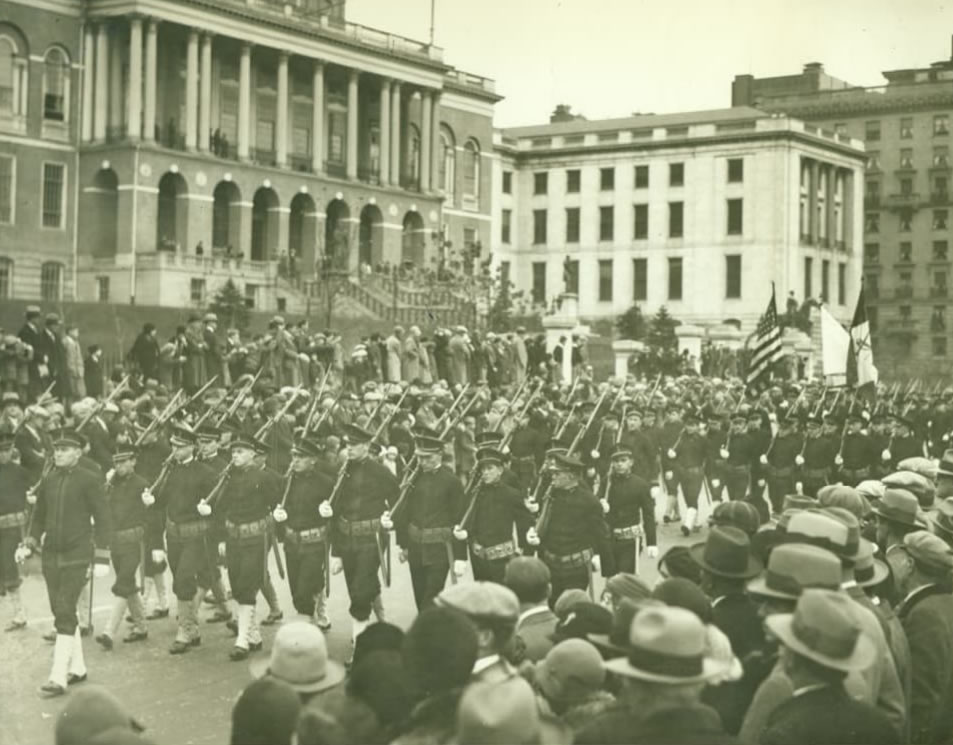
By the third Armistice Day in 1921, a group of the major churches in Old Cambridge had organized a public meeting in favor of the goals of the upcoming Washington Naval Conference, a gathering of international naval powers to discuss disarmament and the fate of the Pacific region in world affairs. Following the destruction and loss of life in the Great War, Americans – like their counterparts around the world – sought to avoid further conflicts and deescalate international tensions. During the 1920s, Armistice Day commemorations became largely synonymous with pacifism as calls for global cooperation gained popularity. In his proclamation of 1921, Quinn told Cantabrigians that “we should offer up a prayer to the Almighty God that a similar catastrophe may never again be visited upon the world, and that the deliberations of the representatives of all the mighty nations of the earth in conference for the purpose of limiting armament may have his blessing.”
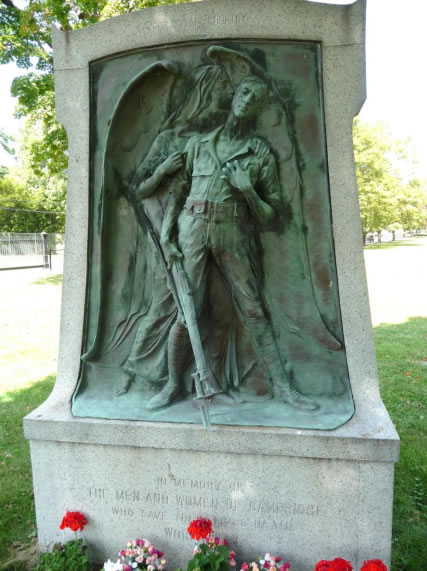
On November 11, 1922, “The Supreme Sacrifice” by Karl Skoog, a monument to the Cambridge men and women who died in the war, was dedicated at the Cambridge Cemetery. The Cambridge Tribune described the scene:
“In a semicircle about the monument were more than 2000 relatives of the city’s World War dead. Color guards of the various organizations were grouped on either side and ex-service men formed a hollow square about the monument. John D. Crowley Jr., 6-year-old son of the commander of the Cambridge post, unveiled the monument, while the post’s rifle team fired the military salute.”
Skoog’s monument depicts a soldier being embraced by the Angel of Death at the moment of surrender. The dedication ceremony was as emotionally wrought as the sculpture. The event’s remarks concluded with, “As they served America in time of war, yielding their last full measure of devotion, may we serve America in time of peace, so living that justice, freedom and democracy may endure forever.” The best way to honor those who had given their lives in war was to work for peace.
As the 1920s progressed, Armistice Day continued to be a commemoration of war and an inspiration for peace. The League of Nations, formed in 1920, was designed as a means of effective communication and cooperation among world countries. The Permanent Court of International Justice was the legal arm of the League, allowing for those who broke international law to be brought to justice in a courtroom rather than on the battlefield. This desire for diplomatic channels by which countries could solve problems made Armistice Day unique in the minds of Cantabrigians, and attempts during this decade to combine the holiday with Navy Day, Defense Day, and Flag Day met with substantial opposition.
On the 10th Armistice Day in 1928, the Chronicle reported on a window display at the Inman Trust Co. in Central Square. Containing two local newspapers announcing the 1918 armistice, the window also featured “a beautiful poster calling attention to the unity of the many races and creeds that have been blended together to form the present day America.” The ability of diverse races and nationalities to work together peacefully was now the ideal, whether across the globe or right at home in Cambridge, and Armistice Day became a day to recommit to those aspirations. Just over a decade later, much of the world would be plunged into another world war, but for a brief period, peace and international cooperation seemed not only possible but the most appropriate way to commemorate all that the city and the nation had lost in World War I.