3) Josiah Royce House
103 Irving Street
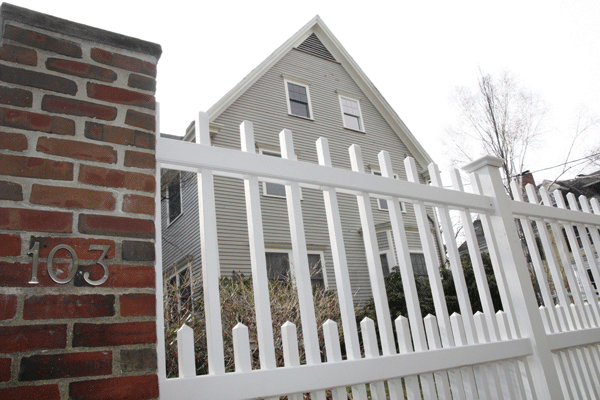
Just like the James home, the Royce home was built in 1889.
For nearly 30 years, Josiah Royce and William James were colleagues in the same department of philosophy at Harvard. During most of that time, they lived as neighbors where, on returning from class, they often entered into lengthy and sometimes heated philosophical discussions. Royce and James had always disagreed deeply concerning the proper understanding of religious phenomena in human life. Their friendly longstanding dispute was known as the Battle for the Absolute.
Contrary to the open-ended pluralism and pragmatism of James, Royce was convinced that the object and source of religious experience was an actual, infinite, and superhuman being. As Alice James once said, Royce carried “his Infinite under his arm.”
In 1899 and 1900 Royce delivered the Gifford lectures at the University of Aberdeen, which were published as The World and the Individual.
When James delivered the Gifford Lectures in 1901 and 1902, he directed many arguments against Royce's idealism, though he did not target his friend by name. James's lectures were published as the popular and academic success The Varieties of Religious Experience.
Though the two were very different, James quite charming and Royce socially awkward, James trim and smartly dressed and Royce stocky and frumpy, they remained close friends throughout their lives. While William was on sabbatical in 1892, Royce wrote to him that “Cambridge without you is like toast unbuttered, like the heart without blood.”
Note: The property was later home to Julia Child and her taped cooking shows. Child sold the house and spent her last years in California, but in 2001 the kitchen in its entirety was removed and sent to the Smithsonian’s National Museum of American History.